The Card Between Your Two Obstacles Is the Answer. Here's How to Read It.
 By Bill Hajdu, the Firepig · November 25, 2026 · 8 min read
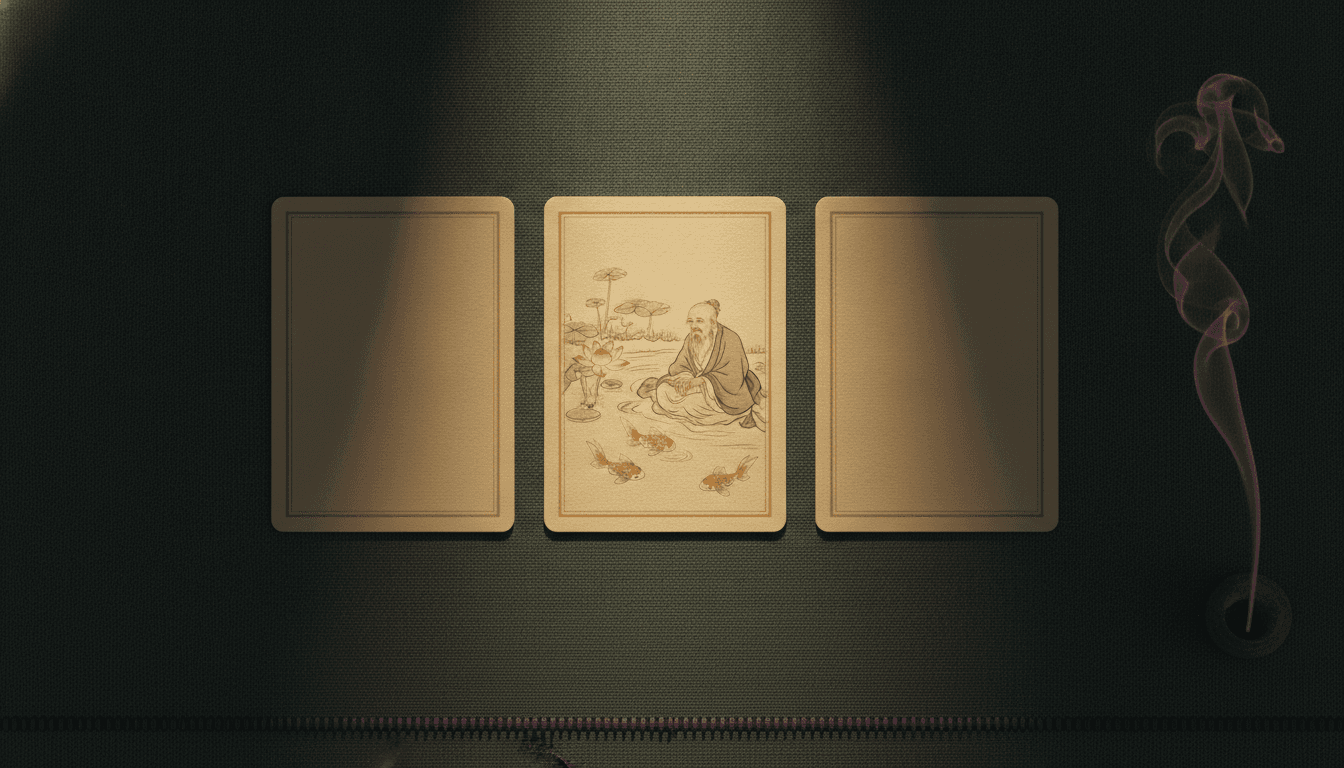
The answer was on the table Monday. It sat between the two cards you were staring at.
Monday I showed you the West position: two cards standing in your way, and the hard truth that sometimes the opposition is you. Today you want the way through. Good. Look again at the spread.
In the Mahjong Mirror, the West position holds three cards. The two on the outside are the obstacles. The card in the middle is the solution. I'll say it plainly: that center card is the most crucial card in the whole West position, and it is the hardest to read. Not because it hides. Because it gives you direction, not instructions. It says "go north." It does not say "take this road, turn at the river, stop before dark."
Turning direction into a plan is the work. And it is work you can do. Here is how I do it, step by step.
Why the answer sits inside the problem

Within every challenge lies the seed of its own resolution. That is not a greeting card. It is where the cards physically sit. Opposition and solution are two parts of one whole, and the cards put them shoulder to shoulder.
Take the Pine in the center of the West. The Pine means perseverance. Put it next to the Willow, the card of weakness, of bending too easily, and the message is clear: your tendency to yield is the problem, and steadfastness is the way out. Fine. But persevere with what? How? For how long? The card will not say. That is the moment most people nod, thank me, go home and change nothing.
The center card tells you which way to walk. It does not walk for you.
So don't stop at the direction. Do the six steps.
Step 1: Name the obstacle in one sentence
Action: Go back to Monday's four questions and write the obstacle down as a single sentence. Not a paragraph. One line.
Why: A plan built against a vague enemy is a vague plan. If you cannot say what is in your way in one breath, you have not found it yet. Keep digging until you can.
Step 2: Find the real arena
Action: Look at which suit dominates your spread. If the Bamboo suit is everywhere, relationships are the real current, even when the question looks like something else. If the Coin suit dominates, it is money. If the Wan suit dominates, the matter is emotional, intellectual or spiritual.
Why: A career problem can have relationship roots. A money problem can be a confidence problem wearing a suit. In over 35 years of doing readings, I have watched a lot of people solve a problem they did not have. Plan for the right arena or you will fix the wrong thing well.
Step 3: Write three lines and see if they tell one story
This is the heart of the method, and it is the most important insight in the whole book.
Three center cards run through a Mahjong Mirror reading: the Central Theme card, which names the core issue; the center card of the West, which is your solution; and the center card of the East, which is what you truly want.
Action: Write one line for each. What is the core issue? What is my approach? What do I truly want? Then read the three lines together.
Why: When they tell one coherent story, the path is clear. Heaven as the theme: significant change. Pine as the solution: perseverance. Phoenix as the want: happiness. Read it as a sentence: you are in a time of real transition; hold steady through it and you will find the happiness you want. One story. You can act on that.
Now a spread that clashes. Red Dragon as the theme: ambition. Carp as the solution: peaceful acceptance. South as the want: achievement. The solution says accept. The heart says achieve. That solution will not satisfy, and if you follow it you will feel like you are betraying yourself every morning.
The old Chinese frame for this is tian, di, ren: heaven, earth and humanity. When the three align, prosperity follows. When they don't, no amount of effort fixes it. The rule I use: if the approach does not serve both the issue and the want, change the approach.
I'll give you mine. Coming up on my 75th birthday I was newly engaged. My fiancée was born in a Rooster year and had a teenage son. I did a reading. Central Theme: stress. East center: I truly wanted this relationship, deep love and real connection. West center: the Carp.
The Carp card shows an elderly man sitting peacefully by a pond, watching goldfish. Everyone knows the legend of the carp that leaps the Dragon Gate and becomes a dragon. But that is not what the card shows. It shows the calm elder, not the struggling fish. The message was: cultivate inner peace and acceptance. Flow with the stress rather than fight it. Stress, acceptance, love. Three lines, one story. Had the Sword sat in that center spot instead, the advice would have been to cut back on commitments. A different plan entirely, and a different year.
Step 4: Turn the direction into specific steps
Action: Take the center card's direction and make it concrete. What exactly. When. Who. I was an Air Force officer, and the habit of writing a detailed program plan never left me. What is the task, when does it happen, who does it. If your plan doesn't have those three, it is a wish.
Why: The card leaves the specifics to you on purpose, and context decides. Say the obstacle card is the Tiger, trouble with authority, and the solution is the House, which means home or office. Which one? I ask the client. She knows. The Sword as a solution means something needs to be cut away; your job is to name the thing. Heaven as a solution means significant change is needed; your job is to say what changes and when.
Then talk it through with someone wise. You are too close to it. A good friend, a mentor, or me across the table. Say the plan out loud and watch where it wobbles.
Step 5: Check the timing
Action: Look for the timing cards. The Green Dragon says act now. The Tortoise says go slowly and be patient.
Why: The right plan at the wrong speed is the wrong plan. Acceptance done in a hurry is not acceptance. A cut made too late leaves a scar. Match the solution to the timing the cards give you, not the timing your anxiety wants.
Step 6: Plan, but leave room for one surprise
Action: Build the plan with structure, and leave one open door for the unexpected. The Mushroom card is the unexpected, and it shows up whether you planned for it or not.
Why: Sun Tzu said the winning general "makes many calculations in his temple before the battle is fought." He also said that "according to circumstances, one should modify one's plans." Both are true. Calculate hard. Then hold the plan with an open hand.
A word to the wise
The card between your two obstacles is the answer. It was never going to spell the answer out. That is your part: name the obstacle, find the real arena, write your three lines, make the direction specific, check the clock, leave a door open. Six steps. Do them and the reading stops being a nice afternoon and starts being a plan you actually follow.
Skip them, and the next reading will show you the same two obstacles with the same card sitting patiently between them. The year doesn't care how long you take. You should.
The full method, with the cards and their meanings, is in Chapters 6 and 7 of The Mahjong Mirror: Your Path to Wiser Decisions. Read those two chapters and do the six steps on your own spread.
And if you want to sit across from me and watch your own three center cards line up, or clash, book a reading. I'm the Firepig. I'll tell you which way to walk, and then we'll build the plan together.
Frequently Asked Questions
How do I turn a mahjong reading into a plan I can actually follow?+
What does it mean when the solution card in my reading goes against what I actually want?+
How can I tell whether my mahjong reading is really about love, money or something inside me?+
Which mahjong cards tell me whether to act now or wait?+
What does the Carp card mean when it comes up as the answer in a mahjong reading?+
More Articles


See what the cards say about your year
A personal reading with Bill turns the year’s energy into decisions you can act on.
Book a ReadingExplore the Book